
The head of the UN's climate science panel, Jim Skea, has expressed concern over the accelerating pace of climate impacts, saying scientists have been surprised by the speed of temperature rise. Skea attributed the worsening situation to inaction on climate change and highlighted the need for urgent action to reduce greenhouse gas emissions. He also addressed concerns about the scientific messaging and the perception of imposed climate policies, emphasizing the importance of involving societies and people in climate change action.

More than twice as much global glacier mass will remain if countries restrict temperature rise to 1.5 degrees Celsius, compared to the warming level of 2.7 degrees Celsius resulting from the current policies, says a new study released.

The planet experienced its warmest January on record last month despite the development of La Nia, a climate pattern that usually brings cooler global temperatures, the European climate agency said on Thursday. This comes on the heels of the Earth experiencing its hottest year on record in 2024, also the first to see global average temperatures rise 1.5 degrees Celsius above pre-industrial levels. According to the Copernicus Climate Change Service (C3S), January 2025 recorded an average temperature of 13.23 degrees Celsius, 0.09 degrees warmer than the previous hottest January (2024) and 0.79 degrees above the 1991-2020 average. Scientists also found that the Earth's temperature in January was 1.75 degrees Celsius higher than pre-industrial levels. Global temperatures have stayed above the 1.5-degree mark for 18 of the last 19 months.

Climate scientists warn that climate change is intensifying heatwaves in India, with the cooling effects of La Nia potentially becoming less effective in a warmer future. The India Meteorological Department (IMD) predicts an early summer with above-normal temperatures and intense heatwave spells, following an unusually dry winter and the warmest February since 1901. Experts emphasize the role of human-caused climate change, along with natural climate drivers like El Nio and La Nia, in shaping weather patterns. While La Nia typically brings cooler temperatures, scientists suggest that under climate change, its ability to mitigate heatwaves may be diminished.

The year 2024 was the hottest year on record, with the global average temperature exceeding 1.5 degrees Celsius above pre-industrial levels for the first time, according to the European climate agency Copernicus. Every month from January to June was the warmest ever recorded, and from July to December (except August), each month was the second warmest on record. Scientists are warning that the world is entering a new climate reality, with extreme heatwaves, floods, and storms becoming more frequent and severe. The report also highlights the failure of developed nations to meet their climate finance commitments to developing countries, despite the urgency of the situation.
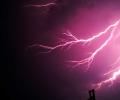
Lightning claims more lives in India annually than any other extreme weather event. Between April and July this year alone, 1,621 people died due to lightning strikes.

The UK body's forecast comes after the UN agency World Meteorological Organisation warned that there is more than 50 per cent chance of El Nino happening this year. El Nino is caused by an abnormal warming of the eastern Pacific Ocean and its impact would cause droughts and floods.

'The intensity and frequency of heatwaves will be much higher than in previous years over Punjab, Haryana, Rajasthan, Gujarat, Madhya Pradesh and Odisha.'

'It is high time to recognise that this is the greatest issue India is confronting.' 'Even the BJP should be raising concerns because polluted air suffocates everybody's child.'
The name 'Nargis' means daffodil in Urdu for the cyclone was suggested by Pakistan to the India Meteorological Department, which is a Regional Specialised Meteorological Center recognised by the World Meteorological Organisation, IMD Director B P Yadav told PTI. IMD has the mandate to provide weather advisories to seven countries -- Bangladesh, the Maldives, Myanmar, Oman, Pakistan, Thailand and Sri Lanka besides India.
The name 'Laila' which means dark-haired beauty or night in Persian was suggested by Pakistan to the India Meteorological Department (IMD) which is tasked by the World Meteorological Organisation to track and name cyclones in the northern Indian Ocean, an IMD official said.

A total of 33 teams have been earmarked by the National Disaster Response Force (NDRF) to undertake relief and rescue operations in Gujarat and Maharashtra ahead of the expected landfall of cyclone 'Biparjoy' near the Jakhau port in Kutch district, officials said on Wednesday.
The India Meteorological Department (IMD) seems to have taken a cautious stand over the World Meteorological Organisation's (WMO) projection of a 'poor monsoon' due to a probable 'El Nino' impact. The IMD did not agree with WMO's projections, saying, "El Nino and the progress of monsoon are not mutually exclusive events", and remained non-committal over its earlier projection of a "normal monsoon" for the June-September 2009 season.
A dedicated system to make district-wise, five-day forecasts can effectively deliver at one-tenth the Met's expenditure.

In Professor Sulochana Gadgil's passing, India has lost a scientific giant, a fierce intellect, and a compassionate soul, remembers Dr Madhavan Nair Rajeevan.
We should be prepared for any impact of the dreaded weather pattern.

Paucity of monsoon rainfall alone is not a sufficient determinant of drought, maintains the World Meteorological Organisation.

Gore, who was US President Bill Clinton's deputy in 2000, made the 2006 Oscar-winning documentary An Inconvenient Truth, after which he was seen as a champion of environmental issues and climate change.

'Nobody asked us to work on this. It was on our own that we decided to embark on this journey.'
The global mean surface temperature was 0.48 degrees Celsius above the 1961-1990 annual average, the World Meteorological Organisation said.
There is a substantial possibility of the emergence of La Nina, the opposite of El Nino, which invariably has a positive influence on the monsoon.

The independent group of scientists and communicators previously said that winters are quickly transitioning into summer-like conditions in north India, shortening the spring season.

The heat index in major metro cities in the country has majorly risen since 2010 compared to a decade earlier.

The World Meteorological Organisation (WMO) has officially confirmed that 2023 is the hottest year on record by a huge margin, smashing global temperature records.

'A few answers for the reason of the crash will be known -- whether it was a technical fault, design issue, human error etc.'

The World Meteorological Organisation/Economic and Social Commission for Asia and the Pacific Panel on Tropical Cyclones, at its twenty-seventh session held in 2000 in Muscat, Oman, agreed to assign names to the tropical cyclones in the Bay of Bengal and Arabian Sea.

The first five months of 2023 have witnessed at least six major events/trends that augur badly for global economic and socio-political prospects, points out Shankar Acharya, former chief economic adviser to the Government of India.

The warmest six years have all been since 2015, with 2016, 2019 and 2020 being the top three. The differences in average global temperatures among the three warmest years are indistinguishably small. The average global temperature in 2020 was about 14.9C, 1.2 ( 0.1) C above the pre-industrial (1850-1900) level.
In Rajasthan, Pilani recorded 44.9 degrees Celsius, Phalodi and Churu touched 43.8 degrees Celsius and 43.5 degrees Celsius respectively, while Bikaner and Jaipur registered 43.4 degrees Celsius and 43 degrees Celsius.

A low-pressure area, set to form over east central Bay of Bengal on May 22, is likely to intensify into a cyclonic storm and strike the Odisha-West Bengal coast on May 26, the Met department said on Thursday, sparking fears of another Amphan-like catastrophe.

How can a cyclonic storm that could make landfall at India's eastern coastline with winds blowing in the range of 120 to 140 km per hour be named Hudhud?

The global body added that national meteorological and hydrological departments in both countries are working closely with health and disaster management agencies to roll out heat health action plans.

Twelve out of the 15 warmest years since 1901 were during the past 15 years -- between 2006 and 2020, according to IMD data.

Super cyclone Mocha made landfall along the Myanmar-Bangladesh coasts on Sunday after intensifying into the equivalent of a category-five storm, a senior Met official said.

The economy is likely to log in a tepid 6 per cent growth next fiscal, in line with the consensus estimates, rating agency Crisil said on Thursday. The agency also sees the economy averaging a growth rate of 6.8 per cent over the next five fiscals. Crisil further said it expects the corporate revenue to log in double-digit rise again next fiscal.

Heavy rain in the first week of July compensated for the shortfall but caused flooding in many northeastern states.

Tomato prices have been on the boil for more than a month. Data from major cities show that the spike has been between 125 and 150 per cent at the wholesale level. Soaring vegetable prices, including tomatoes, pushed the retail inflation rate to a nine-month high of 5.49 per cent in September, according to government data. Though reports say prices are expected to come down in the next few weeks after supplies improve from Madhya Pradesh and Himachal Pradesh, how long will the respite last is anybody's guess.

The new records for extreme lightning bursts, or 'megaflashes', during 2019, are more than double the size and duration of the previous record flashes.

Temperatures in 17 locations breached 48 degrees Celsius on Monday, with the relentless heat affecting health and livelihoods across large parts of northwestern and central India.
